
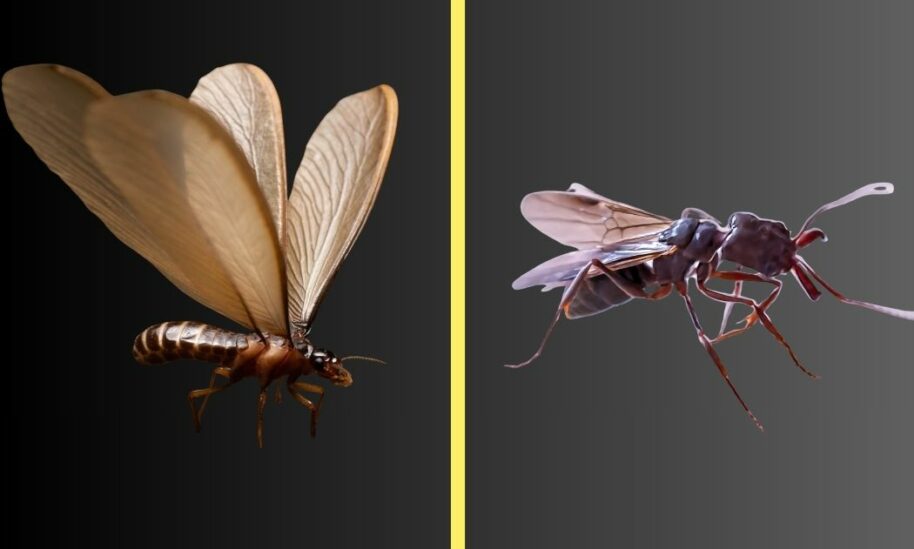
Springtime brings warmer weather, blooming flowers, and for many homeowners, the sudden and unnerving appearance of winged insects buzzing around the windows. It is incredibly common to spot a cluster of these flying bugs and confidently dismiss them as “just flying ants.”
Unfortunately, that casual dismissal is one of the most expensive mistakes a homeowner can make. Those winged insects might not be ants at all. They could be termite “swarmers” (alates)—the reproductive members of a mature termite colony looking to establish a new nest right inside your walls.
The High Stakes of Mistaken Identity
To understand why this mix-up is so dangerous, you have to understand the life cycle of a termite. Termite colonies live deep underground or hidden entirely within the wood of your home. You rarely see the pale, blind “worker” termites that actually eat your wood.
However, once a colony matures—usually after three to five years—the queen begins producing winged reproductive termites called swarmers. On a warm spring day, usually following a rainstorm, hundreds of these swarmers will emerge from the nest simultaneously in a “nuptial flight.” Their sole purpose is to find a mate, shed their wings, and start a brand-new colony.
If you see swarmers inside your house, it rarely means they just flew in through an open door. It almost always means you already have an established, mature colony living inside your walls or foundation, and they are trying to expand. While flying ants can certainly be a nuisance (and Carpenter Ants can cause their own wood damage), termites are a silent catastrophe, causing over $5 billion in property damage annually.
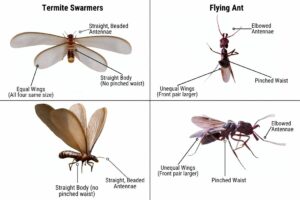
The 3 Key Differences: A Visual Breakdown
If you manage to trap one of these winged invaders or find a dead one on your windowsill, grab a magnifying glass or zoom in with your smartphone camera. Look closely at these three distinct physiological traits to determine exactly what you are dealing with:
1. The Antennae: Bent vs. Straight
- Flying Ants: Have “elbowed” antennae. If you look closely, the antennae bend sharply in the middle, almost like a human arm bent at the elbow.
- Termite Swarmers: Have completely straight antennae. They do not bend, and upon close inspection, they look like tiny strings of microscopic beads.
2. The Waist: Pinched vs. Broad
- Flying Ants: Possess the classic insect body profile. They have a severely pinched, narrow waist connecting their thorax and abdomen, giving them a very segmented, three-part appearance.
- Termite Swarmers: Have a thick, broad waist. Their body looks like one continuous, straight line or a long capsule without any distinct pinching or segmentation in the middle.
Still not sure what you’re looking at? Bug identification isn’t always easy, especially when you’re dealing with insects less than half an inch long. Don’t guess when your property is on the line. Reach out to Hoffman’s Exterminating through our Contact Page for professional identification and rapid eradication.
3. The Wings: Unequal vs. Equal Length
- Flying Ants: Have two pairs of wings, but they are visibly disproportionate. The front wings are significantly larger and longer than the hind wings. Additionally, ant wings tend to have a slightly brownish or yellowish tint.
- Termite Swarmers: Also have two pairs of wings, but both sets are exactly the same size and length. Their wings are often much longer than their actual bodies, making them look somewhat clumsy. Termite wings are generally translucent, milky-white, and have a distinct, glass-like appearance.
The Aftermath: Discarded Evidence
Sometimes, you miss the actual swarm entirely. Termite swarms are notoriously short-lived. They fly toward light sources, mill around for 30 to 40 minutes, and then quickly drop to the ground.
Once a termite swarmer finds a mate, its wings snap off effortlessly—by design. Often, the only evidence a homeowner finds of a termite swarm is a massive pile of discarded, translucent wings left behind on windowsills, in spider webs, or scattered across the floor near sliding glass doors. Flying ants, on the other hand, do not typically shed their wings in massive, centralized piles after a flight. If you are finding piles of delicate, equal-length wings inside your house, it is almost certainly a termite emergency.
Act Quickly to Protect Your Home
Dismissing winged insects as “just flying ants” allows termite colonies to feed on your home’s structural supports 24 hours a day, 7 days a week, completely unabated. Even if the pests do turn out to be ants, swarms of flying ants indoors often indicate a Carpenter Ant infestation, which requires its own specialized treatment to prevent wood damage.
Take back control of your home today. Whether you are dealing with nuisance ants, destructive carpenter ants, or a full-blown termite colony, Hoffman’s Exterminating has the tools, technology, and expertise to stop them in their tracks. We offer comprehensive Pest Control, Termite Control, Bed Bug Extermination, Wildlife Removal, and more.
Follow Hoffman’s Facebook page for more pest control tips, advice and news.